





What Is Nutrient Lockout, and How Do You Fix It Fast?
There's a particular kind of frustration that comes with doing everything "right" and still watching your plants struggle. You're feeding on schedule, your lights are fine-tuned, your environment is stable, and yet the leaves are yellowing, curling, or stalling out anyway. Nine times out of ten, growers land on the same diagnosis: nutrient lockout.
It's one of the most talked-about issues in hydroponics and soil growing alike, and for good reason. Lockout doesn't always look like what you'd expect; it can mimic a straightforward deficiency, it can appear even when your reservoir is perfectly mixed, and if you treat it the wrong way, you can end up making it worse. Let's get into what's actually happening at the root zone, why it happens, and how to fix it without guessing.
What Is Nutrient Lockout?
Nutrient lockout is what happens when the nutrients in your growing medium or reservoir are present, sometimes in generous amounts, but your plant simply can't take them up. The nutrients are there. The roots just can't access them.
This is a crucial distinction, because it means lockout isn't a feeding problem; it's an availability problem. You can pour on more nutrient solution and see no improvement at all, because the issue was never a lack of supply. In some cases, adding more actually deepens the lockout, which is exactly why diagnosis matters more than reaction.
What's the Difference Between Chemical and Physical Lockout?
Lockouts tend to fall into two categories, and each calls for a different fix.
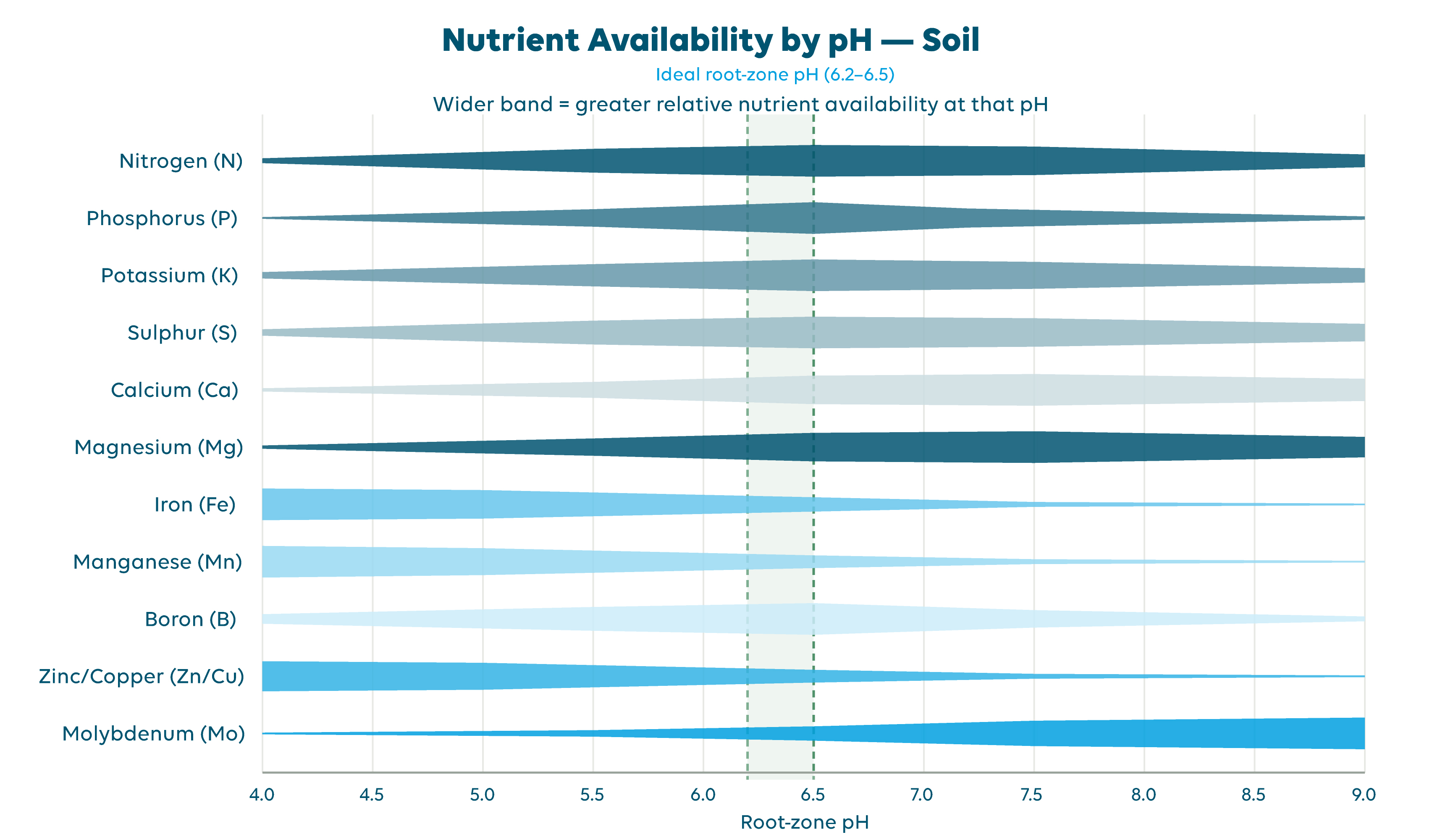
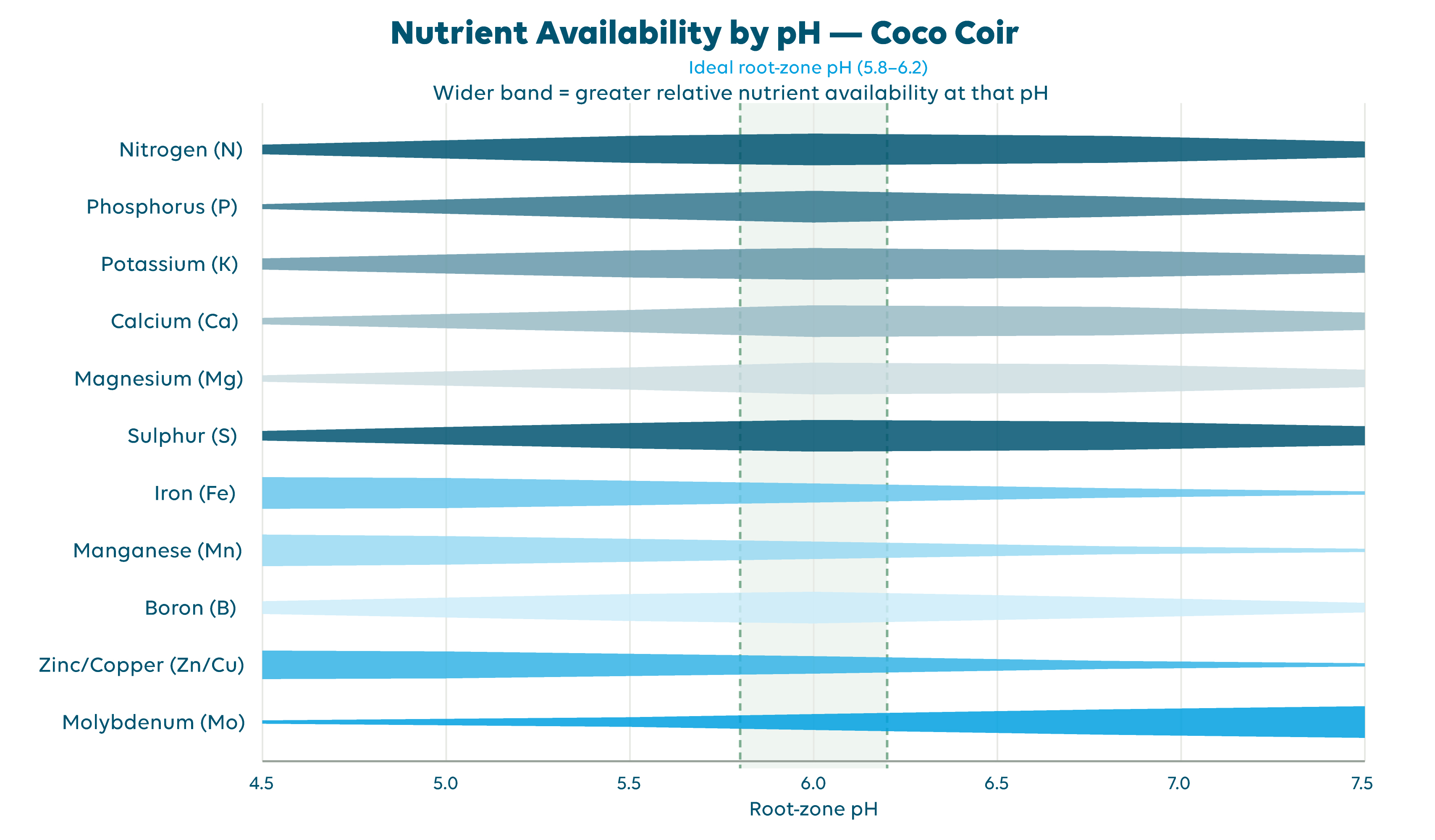
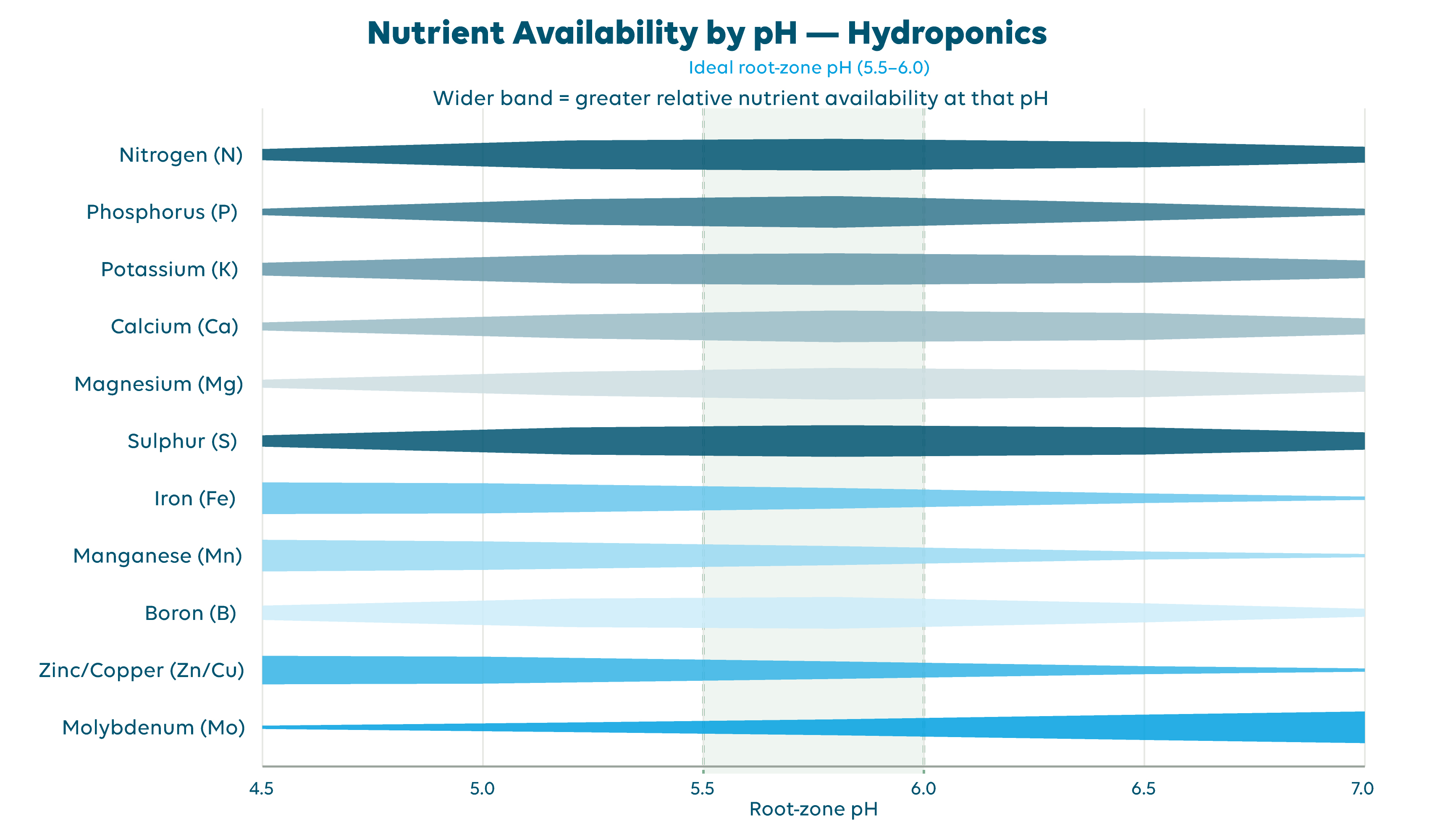
Chemical lockout happens when your root zone pH drifts outside the range where certain nutrients stay soluble. Every element has a pH window where it's available to the plant; iron and manganese prefer a slightly acidic pH, while phosphorus and calcium have their own preferred zones. Once pH drifts too far in either direction, specific nutrients chemically bind up or convert into forms your plant can't absorb, even though they're still physically present in the medium.
Physical lockout is more of a traffic jam. It happens when salts build up around the root zone faster than the plant can use them or than water can move them through. Over time, this accumulation raises your EC (electrical conductivity) at the root, creates an increasingly hostile environment for root hairs, and can begin to affect osmotic pressure, meaning the plant struggles to draw up water and nutrients together, even when both are technically available.In practice, most real-world lockout is a blend of the two. A pH drift causes certain elements to become unavailable, slows the uptake of the remaining ions, and allows unused salts to accumulate in the root zone, compounding the original problem.
What Causes Nutrient Lockout in the First Place?
pH drift is the number one cause. Every medium has a different sweet spot, and once you're outside it, availability drops off fast for certain nutrients. Soil is the most forgiving thanks to its natural buffering capacity, coco is moderately sensitive, and hydro systems are the least forgiving of all, since there's no medium to buffer swings.
Medium Ideal Root-Zone pH: Soil 6.2–6.5, Coco 5.8–6.2, Hydro 5.5–6.0
Over-fertilising is the second big one. It's a natural instinct to feed a bit heavier when growth looks slow, but pushing EC too high without giving the plant time to draw it back down just adds to the salt load sitting at the root zone. This is especially common with growers running a strong base nutrient alongside several boosters or additives; the combined EC creeps up without anyone intending it to.
Nutrient antagonism plays a role too. Certain elements compete for the same uptake pathways. Excess calcium can suppress magnesium and potassium uptake, and heavy potassium can crowd out calcium and magnesium in return. This is part of why Cal-Mag issues are so common in coco specifically; coco naturally binds calcium and magnesium through cation exchange, so if your base nutrient isn't accounting for that, your plant can be sitting in a coco slab full of calcium it still can't get to.
Water quality is an underrated factor. Hard water carries its own load of calcium and bicarbonates before you've added a single millilitre of nutrient. If you're not accounting for that baseline, your actual EC and mineral balance can be well off from what your feed chart assumes.
Root zone temperature also matters more than most growers expect. Cold root zones mechanically slow nutrient uptake, regardless of how well-balanced your solution is, while root zones that run too warm increase pathogen pressure and reduce the oxygen available for active uptake.
Nutrient Lockout vs Nutrient Deficiency: What's the Real Difference?
This is the question that trips up even experienced growers, because visually, lockout and deficiency can look almost identical. Yellowing leaves, interveinal chlorosis, tip burn, and stunted growth show up in both cases, so eyeballing the plant alone often isn't enough.
The real diagnostic difference comes down to two things: what your meters tell you and where on the plant the symptoms appear.
A genuine deficiency means the nutrient truly isn't present in sufficient quantity, whether that's due to a light feeding schedule, an unbalanced formula, or a plant in a demanding stage that's outpacing its feed. Your EC readings will often be on the low side, and correcting them is usually as simple as adjusting your feed strength or formula.
Lockout, on the other hand, typically shows up alongside normal or high EC readings and a pH reading that's drifted outside the ideal window for your medium. The nutrient is measurably there in the reservoir or runoff; it's just not making it into the plant. If you test your reservoir or runoff pH and find it's drifted, and your EC isn't low, you're very likely looking at lockout rather than a straight deficiency.
Symptom placement is the other tell. Deficiencies tend to be nutrient-specific and follow predictable patterns; for example, nitrogen deficiency first appears in older, lower leaves because nitrogen is mobile and the plant redistributes it to new growth. Lockout, especially when it's driven by pH swings, tends to affect multiple nutrients at once and can show up more broadly across the plant, because it's blocking a range of elements rather than just one.
This is exactly why a decent pH and EC meter earns its keep. Guessing from leaf colour alone leaves you choosing between two very different fixes, and picking the wrong one wastes time your plant doesn't have.
Product Spotlight: Bluelab pH PenPlus: A reliable pH pen is the fastest way to confirm or rule out lockout before you touch your feed schedule. The pH PenPlus uses a double-junction probe for stable, repeatable readings, and because the probe is replaceable via a simple screw-cap design, you're not stuck buying a whole new pen once a probe starts to wear. Testing both your reservoir and your runoff gives you a clear before-and-after picture of what's actually happening at the root zone, rather than relying on symptoms alone.
How Do You Fix Nutrient Lockout Fast?
Once you've confirmed lockout rather than deficiency, the fastest and most reliable fix is a flush. Running plain, pH-adjusted water (or a dedicated flush solution) through your medium at a volume equal to two to three times the pot or slab size clears accumulated salts in the root zone and resets your starting point.
For hydro systems, a full reservoir drain and refresh achieves the same result, giving roots a clean slate rather than asking them to fight through a backlog of unavailable salts.
Once the flush is done, don't jump straight back to full-strength feed. Reintroduce nutrients at a reduced EC, somewhere around half strength, and dial your pH in carefully to the correct range for your medium before you bring EC back up over the following feeds. Rushing this step is one of the most common reasons for a lockout to return within a week or two of "fixing" it.
Product Spotlight: Grotek Final Flush: While it's best known as a pre-harvest flush, Final Flush works just as well for correcting lockout mid-cycle. It pulls excess, unconverted salts away from the root base rather than adding anything further to the mix, giving an over-fertilised or salt-affected root zone the chance to re-balance. Apply it liberally to the top of the container and let the excess drain freely from the bottom, repeating a second time if needed. Then hold off on your normal feed for about a week before resuming. It's suited to soil, coco, and hydro alike, so it's a handy one to keep on hand regardless of your setup.
Product Spotlight: Bluelab OnePen: For growers who want pH and EC in a single reading rather than switching between two meters, the OnePen measures both, plus temperature, in a single compact pen. It pairs with the Edenic app over Bluetooth, so you can log readings over time and start spotting drift trends before they lead to a full lockout, rather than only catching the problem once symptoms appear on the plant.
How Do You Prevent Nutrient Lockout From Coming Back?
A flush solves the immediate problem, but the real win is not needing one in the first place. A few habits make the biggest difference here.
Test before you correct. Checking pH and EC at every feed, or at minimum every couple of days, means you catch drift while it's still a small adjustment rather than a full-blown lockout.
Feed to the plant, not the chart. Feed charts are a starting point, not a rulebook. If your plant is showing signs of stress at the recommended EC, it's worth stepping back rather than pushing forward.
Address Cal-Mag proactively, especially in coco. Given how readily coco binds calcium and magnesium, growers running coco media often see real benefits from a dedicated supplement rather than relying on the base nutrient alone to keep pace.
Product Spotlight: Nutrifield Calcium Magnesium: Formulated to top up the two elements coco is most likely to tie up, this helps prevent Cal-Mag antagonism from becoming the root cause of a lockout in the first place, particularly useful during the higher-demand stretch of vegetative growth into early flower.
Know your water. Testing your source water's baseline EC and pH means your feed calculations are based on real numbers rather than assumptions, which matters a lot if you're on hard water.
Flush periodically as routine maintenance, not just as an emergency fix. Especially in recirculating or high-frequency fertigation setups, a scheduled flush every couple of weeks keeps salt accumulation from building to the point where it starts affecting uptake.
The Bottom Line
Nutrient lockout isn't a mystery once you know what to look for; it's your plant telling you the nutrients it needs are there but out of reach, usually because of a pH swing, a salt build-up, or both working together. The fix isn't more feed; it's better access: correct pH, manage EC, flush when needed, and keep an eye on the elements, like calcium and magnesium, that are most prone to getting locked away in the first place.
If you're not sure whether what you're looking at is a lockout or a straight deficiency, bring your readings to your local Hyalite store, and we'll help you work through it. Sometimes the fastest fix really is just a second set of eyes and a decent meter.